


According to the Standard Model, matter and antimatter should have been created in equal quantities at the time of the Big Bang – yet our Universe is made almost entirely of matter.
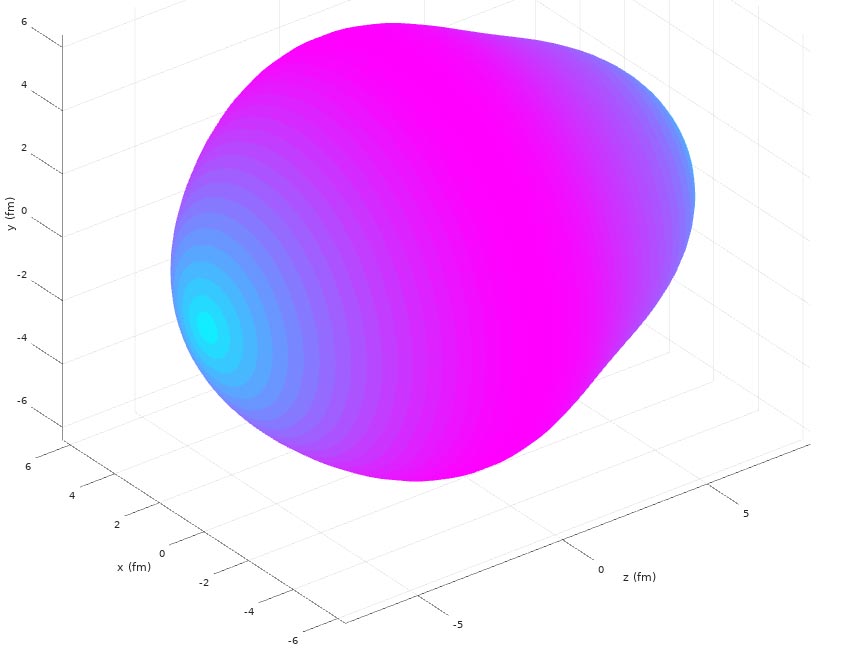
Thorium-228. Credit: Dr. David O’Donnell, UWS
In theory, an electric dipole moment (EDM) could allow matter and antimatter to decay at different rates, providing an explanation for the asymmetry in matter and antimatter in our universe.
Pear-shaped nuclei have been proposed as ideal physical systems in which to look for the existence of an EDM in a fundamental particle such as an electron. The pear shape means that the nucleus generates an EDM by having the protons and neutrons distributed non-uniformly throughout the nuclear volume.
The research team was made up of Dr. O’Donnell, Dr. Michael Bowry, Dr. Bondili Sreenivasa Nara Singh, Professor Marcus Scheck, Professor John F Smith and Dr. Pietro Spagnoletti from UWS’s School of Computing, Engineering and Physical Sciences; and the University of Strathclyde’s Professor Dino Jaroszynski, and PhD students Majid Chishti and Giorgio Battaglia.
Professor Dino Jaroszynski, Director of the Scottish Centre for the Application of Plasma-based Accelerators (SCAPA) at the University of Strathclyde, said: “This collaborative effort, which draws on the expertise of a diverse group of scientists, is an excellent example of how working together can lead to a major breakthrough. It highlights the collaborative spirit within the Scottish physics community fostered by the Scottish University Physics Alliance (SUPA) and lays the groundwork for our collaborative experiments at SCAPA.”

The experiments began with a sample of thorium-232, which has a half-life of 14 billion years, meaning it decays very slowly. The decay chain of this nucleus creates excited quantum mechanical states of the nucleus thorium-228. Such states decay within nanoseconds of being created, by emitting gamma rays.
Dr. O’Donnell and his team used highly sensitive state-of-the-art scintillator detectors to detect these ultra-rare and fast decays. With careful configuration of detectors and signal-processing electronics, the research team have been able to precisely measure the lifetime of the excited quantum states, with an accuracy of two trillionths of a second. The shorter the lifetime of the quantum state the more pronounced the pear shape of the thorium-228 nucleus – giving researchers a better chance of finding an EDM.
Reference: “Direct measurement of the intrinsic electric dipole moment in pear-shaped thorium-228” by M. M. R. Chishti, D. O’Donnell, G. Battaglia, M. Bowry, D. A. Jaroszynski, B. S. Nara Singh, M. Scheck, P. Spagnoletti and J. F. Smith, 18 May 2020, Nature Physics


ConversionConversion ReactionReaction